google-site-verification: googlef8acd466e21ff388.html

Category: Blog

Your blog category

  • AI in Content Marketing

    🚀
    💡
    ✨

    AI in Content Marketing: How to Create Content That Connects With Your Audience
    Anshu Tyagi • October 19, 2026 • 5:12 am

    Hi I’m a digital marketing learner passionate about SEO, content creation, and social media marketing. Through this blog, I share my learning, explore new ideas, and simplify digital marketing concepts for everyone.

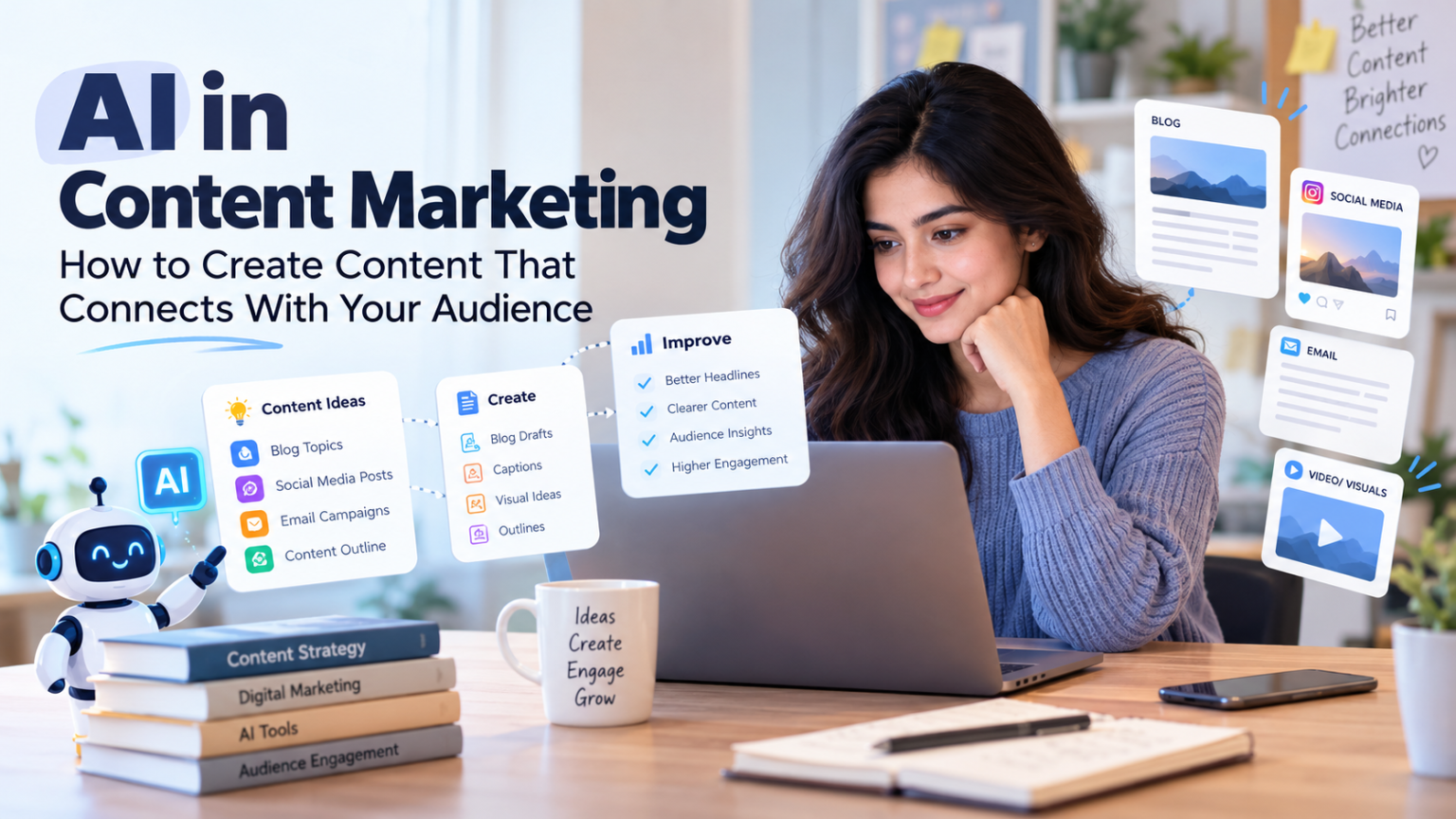
    AI in Content Marketing Main Hero Banner

    Table of Contents

    ▼
    • 1. AI in Content Marketing: How to Create Content That Connects With Your Audience
      • 1.1. Anshu Tyagi
    • 2. AI in Content Marketing: Create Content That Connects
    • 3. How is AI Changing the Way We Create Content?
    • 4. Why Are Marketers Using AI for Content Creation?
      • 4.1. 1. It Saves Time and Effort
      • 4.2. 2. It Helps Marketers Understand Their Audience
      • 4.3. 3. It Makes Content Personalization Easier
    • 5. 3 Practical Ways to Create Better Content With AI:
      • 5.1. 1. Find Fresh Content Ideas
      • 5.2. 2. Create a First Draft and Improve It
      • 5.3. 3. Improve Existing Content
    • 6. AI Content Marketing Tools You Can Try:
    • 7. How to Create an AI-Powered Content Marketing Strategy:
    • 8. Common Mistakes to Avoid When Using AI:
      • 8.1. Conclusion:
    • 9. Want to Learn How AI is Changing Digital Marketing?
    • 10. FAQ’s
      • 10.1. Leave a Reply Cancel reply

    AI in Content Marketing: Create Content That Connects

    Have you ever wondered how some brands manage to create content that grabs your attention and makes you want to know more? It could be a social media post, an interesting blog, or even a simple email that feels like it was written just for you.

    Well, creating such content takes time, creativity, and a good understanding of your audience. But now, artificial intelligence (AI) is making this easier for marketers and digital marketers.

    AI in content marketing is changing how businesses plan, create, and improve their content. From finding fresh ideas to writing engaging captions, AI can help marketers work smarter. But does using AI automatically mean creating better content? Not really! The real magic happens when we combine AI with human creativity and understanding.

    Let’s explore how you can use AI to create content that connects with your audience.

    How is AI Changing the Way We Create Content?

    Creating content takes time, creativity, and a clear understanding of your audience. You need to come up with ideas, research topics, write engaging content, and make sure it connects with the people you’re trying to reach. And honestly, doing all of this consistently can sometimes feel challenging.

    This is where AI is making a difference. AI tools can help content creators brainstorm fresh ideas, prepare blog outlines, write social media captions, personalize messages, and improve existing content.

    For example, imagine you want to write a blog about digital marketing for beginners but don’t know where to start. You can use an AI tool to generate topic ideas, create an outline, or suggest questions your readers might have.

    However, AI shouldn’t replace your creativity or understanding of your audience. Think of it as an assistant that makes your work easier while you bring your own ideas, experiences, and personality to the content.

    If you’re curious about the bigger role AI is playing in digital marketing, read our guide on how AI is transforming digital marketing in 2026 to explore the latest trends, tools, and strategies.

    Why Are Marketers Using AI for Content Creation?

    Creating content regularly isn’t always easy. Marketers need to come up with fresh ideas, understand their audience, write engaging content, and keep up with changing trends. Doing all this manually can take a lot of time and effort.

    This is where AI in content marketing is becoming useful. AI tools can help marketers simplify their work, explore new ideas, and create content that is more relevant to their audience. Let’s understand why many marketers are using AI in their content creation process.

    1. It Saves Time and Effort

    Imagine you want to write a blog but don’t know how to begin. Instead of staring at a blank screen, you can use an AI tool to brainstorm ideas, create an outline, or prepare a first draft.

    This helps you get started faster and gives you more time to improve the content, check facts, and add your own perspective.

    2. It Helps Marketers Understand Their Audience

    Creating content without understanding your audience is like talking to someone without knowing what they need.

    AI tools can help analyze customer feedback, organize common questions, and identify topics that may interest your audience when you provide relevant information.

    For example, if you are targeting digital marketing beginners, you might discover that they want to learn about SEO basics, content writing, and useful AI tools. You can then create content around these topics.

    3. It Makes Content Personalization Easier

    Not every reader has the same needs. A beginner may prefer a simple explanation, while an experienced marketer may want more detailed insights.

    AI can help marketers adapt their messages, examples, and content formats for different audiences. This can make content more relevant and engaging.

    However, AI suggestions should always be reviewed to ensure that the message feels natural, accurate, and appropriate for the intended audience.

    3 Practical Ways to Create Better Content With AI:

    Now that we understand why marketers are using AI, let’s see how you can actually use it in your content creation process. You don’t need to be a technical expert to get started. With the right approach, AI in content marketing can help you create useful, engaging, and audience focused content.

    1. Find Fresh Content Ideas

    Sometimes, the hardest part of creating content is deciding what to write about. You might have a blog to publish or social media posts to plan, but your mind feels completely blank.

    This is where AI can help. You can use AI content marketing tools like ChatGPT or Google Gemini to brainstorm blog topics, suggest social media ideas, and identify questions your audience might be asking.

    For example, if your audience consists of digital marketing beginners, you could ask an AI tool to suggest five blog topics about content writing, SEO, or social media marketing.

    Use these suggestions as a starting point, then choose the ideas that best match your audience’s needs.

    2. Create a First Draft and Improve It

    Once you have an idea, the next step is turning it into content. AI can help you prepare a blog outline, organize your thoughts, or create a first draft.

    For example, if you want to write a blog about email marketing, you can ask an AI tool to suggest an introduction, relevant headings, and practical examples.

    But here’s the important part: don’t copy and publish the draft without reviewing it. Check the facts, add your own examples, remove unnecessary information, and make sure the writing sounds natural.

    AI can help you get started, but your creativity and understanding of your audience make the content more personal and meaningful.

    3. Improve Existing Content

    Creating content doesn’t always mean starting from scratch. Sometimes, an older blog or social media post simply needs a little improvement.

    You can use AI content marketing tools to simplify complicated sentences, suggest clearer headings, improve readability, or repurpose a blog into shorter social media posts.

    For example, you could turn one detailed blog into three social media captions, a short email newsletter, and a list of frequently asked questions.

    Before publishing the updated content, review it carefully to ensure that the information is accurate, useful, and consistent with your brand’s voice.

    The goal is not just to create content faster. It’s to make your content clearer, more helpful, and more engaging for the people reading it.

    AI Content Marketing Tools You Can Try:

    • ChatGPT: Useful for brainstorming ideas, creating outlines, drafting content, and rewriting sentences.
    • Google Gemini: Can help with research assistance, idea generation, and content planning.
    • Grammarly: Helps review grammar, clarity, and tone.
    • Canva: Offers AI-powered features for creating and editing visual content.
    • Jasper: Provides AI-assisted content creation features for marketing teams.

    Each tool serves a different purpose, so choose one based on your needs rather than trying to use every tool available.

    Want to explore more tools that can simplify your digital marketing tasks? Check out our guide to the 15 best AI tools for digital marketing in 2026 and discover more options for content creation, design, and marketing.

    How to Create an AI-Powered Content Marketing Strategy:

    Using AI randomly may save time, but having a clear plan can make your efforts more effective.

    Here is a simple approach to building an AI-powered content marketing strategy:

    1. Understand your audience: Identify their interests, problems, and frequently asked questions.
    2. Plan your content: Choose relevant topics and decide whether blogs, videos, emails, or social media posts are the best formats.
    3. Use AI for assistance: Generate ideas, organize information, and prepare drafts.
    4. Add the human touch: Include your own perspective, useful examples, and a natural writing style.
    5. Review before publishing: Check facts, grammar, originality, and whether the content actually answers the reader’s question.
    6. Measure performance: Use relevant analytics to understand engagement, clicks, and other meaningful results.

    The goal is not to publish more content just because AI makes it easier. The goal is to publish content that provides real value.

    While planning your content, it’s also important to understand how AI is changing the way people discover information online. Read our guide on SEO vs GEO and how to get your website featured in AI search results to learn more.

    Common Mistakes to Avoid When Using AI:

    While AI can be helpful, there are a few mistakes you should avoid.

    • Publishing without fact-checking: AI can make mistakes, so verify important information..
    • Ignoring your brand voice: Edit the content so it sounds natural and consistent with your brand.
    • Creating generic content: Add original insights and examples instead of repeating common information.
    • Focusing only on quantity: More content doesn’t automatically mean better results.
    • Forgetting your audience: Always ask whether the content is useful to the people you want to reach.

    AI works best when you guide it with a clear purpose and carefully review what it produces.

    Conclusion:

    AI in content marketing is creating new opportunities for businesses, bloggers, and digital marketers. It can help generate ideas, speed up writing, support personalization, and make content planning easier.

    However, creating content that truly connects with your audience requires more than AI tools. You need to understand your readers, share useful information, and communicate in a way that feels natural and trustworthy.

    So, instead of depending entirely on AI, use it to support your creativity. Let it help you get started, but add your own thinking and personality before publishing.

    Because at the end of the day, good content isn’t just about what you publish; it’s about how well you connect with the people reading it.

    Want to Learn How AI is Changing Digital Marketing?

    AI is opening up new possibilities for content creation, social media marketing, SEO, and many other areas of digital marketing. Learning how to use AI tools effectively can help you understand these changes and apply them in your own projects.

    If you’re interested in exploring AI, content marketing, and other digital marketing skills, visit Vidyasarthi Institute of Digital Marketing to explore its digital marketing learning opportunities.

    Keep learning, keep experimenting, and take one step at a time towards building your digital marketing skills!

    FAQ’s

    1. Can AI-generated content affect my brand’s trust and credibility? ▼

    Yes, it can if the content contains incorrect information, feels impersonal, or doesn’t match your brand’s values. To maintain trust, review AI-generated content carefully, check facts, and make sure your message feels genuine and helpful to your audience.
    2. Is AI-generated content original, or can it create plagiarism issues? ▼
    3. How can I measure whether AI-assisted content is actually working? ▼

    Leave a Reply

    Logged in as admin. Edit your profile. Log out? Required fields are marked *
  • AI in Content Marketing : A beginner’s Guide

    AI in Content Marketing: How to Create Content That Connects With Your Audience

    Anshu Tyagi • October 19, 2026 • 5:12 am

    Hi I’m a digital marketing learner passionate about SEO, content creation, and social media marketing. Through this blog, I share my learning, explore new ideas, and simplify digital marketing concepts for everyone.

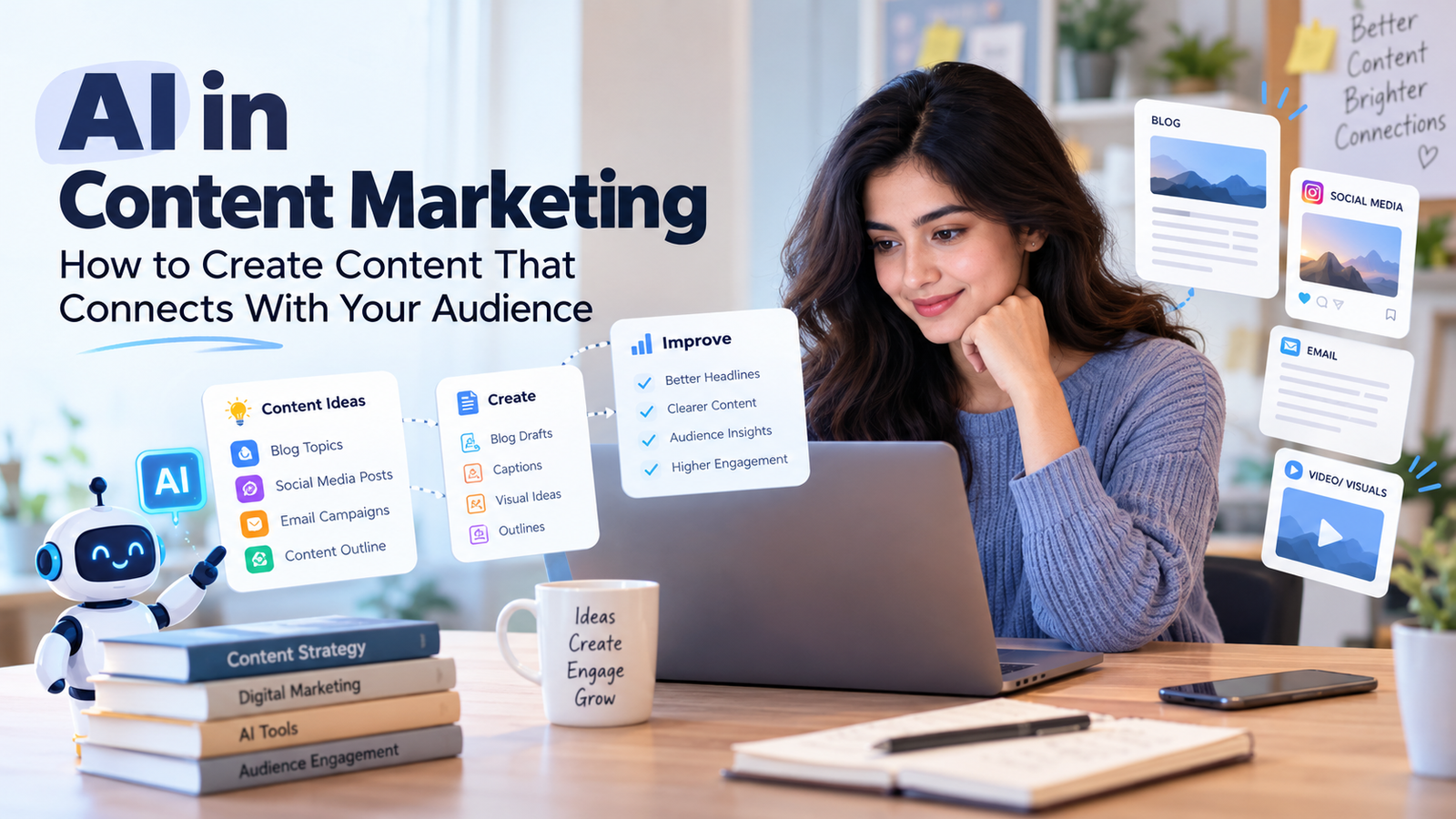
    AI in Content Marketing Header Banner

    Table of Contents

    ▼
    • 1. AI in Content Marketing: How to Create Content That Connects With Your Audience
      • 1.1. Anshu Tyagi
    • 2. AI in Content Marketing: Create Content That Connects
    • 3. How is AI Changing the Way We Create Content?
    • 4. Why Are Marketers Using AI for Content Creation?
      • 4.1. 1. It Saves Time and Effort
      • 4.2. 2. It Helps Marketers Understand Their Audience
      • 4.3. 3. It Makes Content Personalization Easier
    • 5. 3 Practical Ways to Create Better Content With AI:
      • 5.1. 1. Find Fresh Content Ideas
      • 5.2. 2. Create a First Draft and Improve It
      • 5.3. 3. Improve Existing Content
    • 6. AI Content Marketing Tools You Can Try:
    • 7. How to Create an AI-Powered Content Marketing Strategy:
    • 8. Common Mistakes to Avoid When Using AI:
      • 8.1. Conclusion:
    • 9. Want to Learn How AI is Changing Digital Marketing?
    • 10. FAQ’s
      • 10.1. Leave a Reply Cancel reply

    AI in Content Marketing: Create Content That Connects

    Have you ever wondered how some brands manage to create content that grabs your attention and makes you want to know more? It could be a social media post, an interesting blog, or even a simple email that feels like it was written just for you.

    Well, creating such content takes time, creativity, and a good understanding of your audience. But now, artificial intelligence (AI) is making this easier for marketers and digital marketers.

    AI in content marketing is changing how businesses plan, create, and improve their content. From finding fresh ideas to writing engaging captions, AI can help marketers work smarter. But does using AI automatically mean creating better content? Not really! The real magic happens when we combine AI with human creativity and understanding.

    Let’s explore how you can use AI to create content that connects with your audience.

    How is AI Changing the Way We Create Content?

    Creating content takes time, creativity, and a clear understanding of your audience. You need to come up with ideas, research topics, write engaging content, and make sure it connects with the people you’re trying to reach. And honestly, doing all of this consistently can sometimes feel challenging.

    This is where AI is making a difference. AI tools can help content creators brainstorm fresh ideas, prepare blog outlines, write social media captions, personalize messages, and improve existing content.

    For example, imagine you want to write a blog about digital marketing for beginners but don’t know where to start. You can use an AI tool to generate topic ideas, create an outline, or suggest questions your readers might have.

    However, AI shouldn’t replace your creativity or understanding of your audience. Think of it as an assistant that makes your work easier while you bring your own ideas, experiences, and personality to the content.

    If you’re curious about the bigger role AI is playing in digital marketing, read our guide on how AI is transforming digital marketing in 2026 to explore the latest trends, tools, and strategies.

    Why Are Marketers Using AI for Content Creation?

    Creating content regularly isn’t always easy. Marketers need to come up with fresh ideas, understand their audience, write engaging content, and keep up with changing trends. Doing all this manually can take a lot of time and effort.

    This is where AI in content marketing is becoming useful. AI tools can help marketers simplify their work, explore new ideas, and create content that is more relevant to their audience. Let’s understand why many marketers are using AI in their content creation process.

    1. It Saves Time and Effort

    Imagine you want to write a blog but don’t know how to begin. Instead of staring at a blank screen, you can use an AI tool to brainstorm ideas, create an outline, or prepare a first draft.

    This helps you get started faster and gives you more time to improve the content, check facts, and add your own perspective.

    2. It Helps Marketers Understand Their Audience

    Creating content without understanding your audience is like talking to someone without knowing what they need.

    AI tools can help analyze customer feedback, organize common questions, and identify topics that may interest your audience when you provide relevant information.

    For example, if you are targeting digital marketing beginners, you might discover that they want to learn about SEO basics, content writing, and useful AI tools. You can then create content around these topics.

    3. It Makes Content Personalization Easier

    Not every reader has the same needs. A beginner may prefer a simple explanation, while an experienced marketer may want more detailed insights.

    AI can help marketers adapt their messages, examples, and content formats for different audiences. This can make content more relevant and engaging.

    However, AI suggestions should always be reviewed to ensure that the message feels natural, accurate, and appropriate for the intended audience.

    3 Practical Ways to Create Better Content With AI:

    Now that we understand why marketers are using AI, let’s see how you can actually use it in your content creation process. You don’t need to be a technical expert to get started. With the right approach, AI in content marketing can help you create useful, engaging, and audience focused content.

    1. Find Fresh Content Ideas

    Sometimes, the hardest part of creating content is deciding what to write about. You might have a blog to publish or social media posts to plan, but your mind feels completely blank.

    This is where AI can help. You can use AI content marketing tools like ChatGPT or Google Gemini to brainstorm blog topics, suggest social media ideas, and identify questions your audience might be asking.

    For example, if your audience consists of digital marketing beginners, you could ask an AI tool to suggest five blog topics about content writing, SEO, or social media marketing.

    Use these suggestions as a starting point, then choose the ideas that best match your audience’s needs.

    2. Create a First Draft and Improve It

    Once you have an idea, the next step is turning it into content. AI can help you prepare a blog outline, organize your thoughts, or create a first draft.

    For example, if you want to write a blog about email marketing, you can ask an AI tool to suggest an introduction, relevant headings, and practical examples.

    But here’s the important part: don’t copy and publish the draft without reviewing it. Check the facts, add your own examples, remove unnecessary information, and make sure the writing sounds natural.

    AI can help you get started, but your creativity and understanding of your audience make the content more personal and meaningful.

    3. Improve Existing Content

    Creating content doesn’t always mean starting from scratch. Sometimes, an older blog or social media post simply needs a little improvement.

    You can use AI content marketing tools to simplify complicated sentences, suggest clearer headings, improve readability, or repurpose a blog into shorter social media posts.

    For example, you could turn one detailed blog into three social media captions, a short email newsletter, and a list of frequently asked questions.

    Before publishing the updated content, review it carefully to ensure that the information is accurate, useful, and consistent with your brand’s voice.

    The goal is not just to create content faster. It’s to make your content clearer, more helpful, and more engaging for the people reading it.

    AI Content Marketing Tools You Can Try:

    • ChatGPT: Useful for brainstorming ideas, creating outlines, drafting content, and rewriting sentences.
    • Google Gemini: Can help with research assistance, idea generation, and content planning.
    • Grammarly: Helps review grammar, clarity, and tone.
    • Canva: Offers AI-powered features for creating and editing visual content.
    • Jasper: Provides AI-assisted content creation features for marketing teams.

    Each tool serves a different purpose, so choose one based on your needs rather than trying to use every tool available.

    Want to explore more tools that can simplify your digital marketing tasks? Check out our guide to the 15 best AI tools for digital marketing in 2026 and discover more options for content creation, design, and marketing.

    How to Create an AI-Powered Content Marketing Strategy:

    Using AI randomly may save time, but having a clear plan can make your efforts more effective.

    Here is a simple approach to building an AI-powered content marketing strategy:

    1. Understand your audience: Identify their interests, problems, and frequently asked questions.
    2. Plan your content: Choose relevant topics and decide whether blogs, videos, emails, or social media posts are the best formats.
    3. Use AI for assistance: Generate ideas, organize information, and prepare drafts.
    4. Add the human touch: Include your own perspective, useful examples, and a natural writing style.
    5. Review before publishing: Check facts, grammar, originality, and whether the content actually answers the reader’s question.
    6. Measure performance: Use relevant analytics to understand engagement, clicks, and other meaningful results.

    The goal is not to publish more content just because AI makes it easier. The goal is to publish content that provides real value.

    While planning your content, it’s also important to understand how AI is changing the way people discover information online. Read our guide on SEO vs GEO and how to get your website featured in AI search results to learn more.

    Common Mistakes to Avoid When Using AI:

    While AI can be helpful, there are a few mistakes you should avoid.

    • Publishing without fact-checking: AI can make mistakes, so verify important information..
    • Ignoring your brand voice: Edit the content so it sounds natural and consistent with your brand.
    • Creating generic content: Add original insights and examples instead of repeating common information.
    • Focusing only on quantity: More content doesn’t automatically mean better results.
    • Forgetting your audience: Always ask whether the content is useful to the people you want to reach.

    AI works best when you guide it with a clear purpose and carefully review what it produces.

    Conclusion:

    AI in content marketing is creating new opportunities for businesses, bloggers, and digital marketers. It can help generate ideas, speed up writing, support personalization, and make content planning easier.

    However, creating content that truly connects with your audience requires more than AI tools. You need to understand your readers, share useful information, and communicate in a way that feels natural and trustworthy.

    So, instead of depending entirely on AI, use it to support your creativity. Let it help you get started, but add your own thinking and personality before publishing.

    Because at the end of the day, good content isn’t just about what you publish; it’s about how well you connect with the people reading it.

    Want to Learn How AI is Changing Digital Marketing?

    AI is opening up new possibilities for content creation, social media marketing, SEO, and many other areas of digital marketing. Learning how to use AI tools effectively can help you understand these changes and apply them in your own projects.

    If you’re interested in exploring AI, content marketing, and other digital marketing skills, visit Vidyasarthi Institute of Digital Marketing to explore its digital marketing learning opportunities.

    Keep learning, keep experimenting, and take one step at a time towards building your digital marketing skills!

    FAQ’s

    1. Can AI-generated content affect my brand’s trust and credibility? ▼

    Yes, it can if the content contains incorrect information, feels impersonal, or doesn’t match your brand’s values. To maintain trust, review AI-generated content carefully, check facts, and make sure your message feels genuine and helpful to your audience.

    2. Is AI-generated content original, or can it create plagiarism issues? ▼
    3. How can I measure whether AI-assisted content is actually working? ▼
    ✨ ✨ ✨

    Leave a Reply

    Logged in as admin. Edit your profile. Log out? Required fields are marked *
  • AI in Content Marketing: A Beginner’s Guide

    AI in Content Marketing: A Beginner’s Guide

    AI in Content Marketing : How to Create Content That Connects With Your Audience

    Picture of Anshu Tyagi

    Anshu Tyagi

    Hi! I’m a digital marketing learner passionate about SEO, content creation, and social media marketing. Through this blog, I share my learning, explore new ideas, and simplify digital marketing concepts for everyone. ✨

    AI in content Marketing with a Digital Marketer using AI tools to create engaging content

    Table of Contents

    AI in Content Marketing: Create Content That Connects

    Have you ever wondered how some brands manage to create content that grabs your attention and makes you want to know more? It could be a social media post, an interesting blog, or even a simple email that feels like it was written just for you.

    Well, creating such content takes time, creativity, and a good understanding of your audience. But now, artificial intelligence (AI) is making this process easier for content creators and digital marketers.

    AI in content marketing is changing how businesses plan, create, and improve their content. From finding fresh ideas to writing engaging captions, AI can help marketers work smarter. But does using AI automatically mean creating better content? Not really! The real magic happens when we combine AI with human creativity and understanding.

    Let’s explore how you can use AI to create content that connects with your audience.

    How is AI Changing the Way We Create Content?

    Creating content takes time, creativity, and a clear understanding of your audience. You need to come up with ideas, research topics, write engaging content, and make sure it connects with the people you’re trying to reach. And honestly, doing all of this consistently can sometimes feel challenging.

    This is where AI is making a difference. AI tools can help content creators brainstorm fresh ideas, prepare blog outlines, write social media captions, personalize messages, and improve existing content.

    For example, imagine you want to write a blog about digital marketing for beginners but don’t know where to start. You can use an AI tool to generate topic ideas, create an outline, or suggest questions your readers might have.

    However, AI shouldn’t replace your creativity or understanding of your audience. Think of it as an assistant that makes your work easier while you bring your own ideas, experiences, and personality to the content.

    If you’re curious about the bigger role AI is playing in digital marketing, read our guide on how AI is transforming digital marketing in 2026 to explore the latest trends, tools, and strategies.

    Why Are Marketers Using AI for Content Creation?

    Creating content regularly isn’t always easy. Marketers need to come up with fresh ideas, understand their audience, write engaging content, and keep up with changing trends. Doing all this manually can take a lot of time and effort.

    This is where AI in content marketing is becoming useful. AI tools can help marketers simplify their work, explore new ideas, and create content that is more relevant to their audience. Let’s understand why many marketers are using AI in their content creation process.

    1. It Saves Time and Effort

    Imagine you want to write a blog but don’t know how to begin. Instead of staring at a blank screen, you can use an AI tool to brainstorm ideas, create an outline, or prepare a first draft.

    This helps you get started faster and gives you more time to improve the content, check facts, and add your own perspective.

    2. It Helps Marketers Understand Their Audience

    Creating content without understanding your audience is like talking to someone without knowing what they need.

    AI tools can help analyze customer feedback, organize common questions, and identify topics that may interest your audience when you provide relevant information.

    For example, if you are targeting digital marketing beginners, you might discover that they want to learn about SEO basics, content writing, and useful AI tools. You can then create content around these topics.

    3. It Makes Content Personalization Easier

    Not every reader has the same needs. A beginner may prefer a simple explanation, while an experienced marketer may want more detailed insights.

    AI can help marketers adapt their messages, examples, and content formats for different audiences. This can make content more relevant and engaging.

    However, AI suggestions should always be reviewed to ensure that the message feels natural, accurate, and appropriate for the intended audience.

    3 Practical Ways to Create Better Content With AI :

    Now that we understand why marketers are using AI, let’s see how you can actually use it in your content creation process. You don’t need to be a technical expert to get started. With the right approach, AI in content marketing can help you create useful, engaging, and audience-focused content.

    1. Find Fresh Content Ideas

    Sometimes, the hardest part of creating content is deciding what to write about. You might have a blog to publish or social media posts to plan, but your mind feels completely blank.

    This is where AI can help. You can use AI content marketing tools like ChatGPT or Google Gemini to brainstorm blog topics, suggest social media ideas, and identify questions your audience might be asking.

    For example, if your audience consists of digital marketing beginners, you could ask an AI tool to suggest five blog topics about content writing, SEO, or social media marketing.

    Use these suggestions as a starting point, then choose the ideas that best match your audience’s needs.

    2. Create a First Draft and Improve It

    Once you have an idea, the next step is turning it into content. AI can help you prepare a blog outline, organize your thoughts, or create a first draft.

    For example, if you want to write a blog about email marketing, you can ask an AI tool to suggest an introduction, relevant headings, and practical examples.

    But here’s the important part: don’t copy and publish the draft without reviewing it. Check the facts, add your own examples, remove unnecessary information, and make sure the writing sounds natural.

    AI can help you get started, but your creativity and understanding of your audience make the content more personal and meaningful.

    3. Improve Existing Content

    Creating content doesn’t always mean starting from scratch. Sometimes, an older blog or social media post simply needs a little improvement.

    You can use AI content marketing tools to simplify complicated sentences, suggest clearer headings, improve readability, or repurpose a blog into shorter social media posts.

    For example, you could turn one detailed blog into three social media captions, a short email newsletter, and a list of frequently asked questions.

    Before publishing the updated content, review it carefully to ensure that the information is accurate, useful, and consistent with your brand’s voice.

    The goal is not just to create content faster. It’s to make your content clearer, more helpful, and more engaging for the people reading it.

    AI Content Marketing Tools You Can Try :

    There are several AI content marketing tools that can support different stages of content creation.

    • ChatGPT: Useful for brainstorming ideas, creating outlines, drafting content, and rewriting sentences.

    • Google Gemini: Can help with research assistance, idea generation, and content planning.

    • Grammarly: Helps review grammar, clarity, and tone.

    • Canva: Offers AI-powered features for creating and editing visual content.

    • Jasper: Provides AI-assisted content creation features for marketing teams.

    Each tool serves a different purpose, so choose one based on your needs rather than trying to use every tool available.

    Want to explore more tools that can simplify your digital marketing tasks? Check out our guide to the 15 best AI tools for digital marketing in 2026 and discover more options for content creation, design, and marketing.

    How to Create an AI-Powered Content Marketing Strategy :

    Using AI randomly may save time, but having a clear plan can make your efforts more effective.

    Here is a simple approach to building an AI-powered content marketing strategy:

    1. Understand your audience: Identify their interests, problems, and frequently asked questions.

    2. Plan your content: Choose relevant topics and decide whether blogs, videos, emails, or social media posts are the best formats.

    3. Use AI for assistance: Generate ideas, organize information, and prepare drafts.

    4. Add the human touch: Include your own perspective, useful examples, and a natural writing style.

    5. Review before publishing: Check facts, grammar, originality, and whether the content actually answers the reader’s question.

    6. Measure performance: Use relevant analytics to understand engagement, clicks, and other meaningful results.

    The goal is not to publish more content just because AI makes it easier. The goal is to publish content that provides real value.

    While planning your content, it’s also important to understand how AI is changing the way people discover information online. Read our guide on SEO vs GEO and how to get your website featured in AI search results to learn more.

    Common Mistakes to Avoid When Using AI :

    While AI can be helpful, there are a few mistakes you should avoid.

    • Publishing without fact-checking: AI can make mistakes, so verify important information.

    • Ignoring your brand voice: Edit the content so it sounds natural and consistent with your brand.

    • Creating generic content: Add original insights and examples instead of repeating common information.

    • Focusing only on quantity: More content doesn’t automatically mean better results.

    • Forgetting your audience: Always ask whether the content is useful to the people you want to reach.

    AI works best when you guide it with a clear purpose and carefully review what it produces.

    Conclusion :

    AI in content marketing is creating new opportunities for businesses, bloggers, and digital marketers. It can help generate ideas, speed up writing, support personalization, and make content planning easier.

    However, creating content that truly connects with your audience requires more than AI tools. You need to understand your readers, share useful information, and communicate in a way that feels natural and trustworthy.

    So, instead of depending entirely on AI, use it to support your creativity. Let it help you get started, but add your own thinking and personality before publishing.

    Because at the end of the day, good content isn’t just about what you publish; it’s about how well you connect with the people reading it.

    Want to Learn How AI is Changing Digital Marketing?

    AI is opening up new possibilities for content creation, social media marketing, SEO, and many other areas of digital marketing. Learning how to use AI tools effectively can help you understand these changes and apply them in your own projects.

    If you’re interested in exploring AI, content marketing, and other digital marketing skills, visit Vidyasarthi Institute of Digital Marketing to explore its digital marketing learning opportunities.

    Keep learning, keep experimenting, and take one step at a time towards building your digital marketing skills!

    FAQ’s

    1. Can AI-generated content affect my brand’s trust and credibility?

    Yes, it can if the content contains incorrect information, feels impersonal, or doesn’t match your brand’s values. To maintain trust, review AI-generated content carefully, check facts, and make sure your message feels genuine and helpful to your audience.
    AI tools can sometimes produce content that resembles existing material. Although AI-generated content is not automatically plagiarized, you should review your drafts, verify sources, and use plagiarism-checking tools when appropriate. Adding your own insights and examples can also make your content more distinctive.

    You can track metrics based on your content goals, such as engagement, click-through rate, time spent on a page, newsletter sign-ups, or conversions. Compare results with your previous content and look for patterns over time. This helps you understand whether your content is meeting your audience’s needs rather than simply increasing publishing speed.

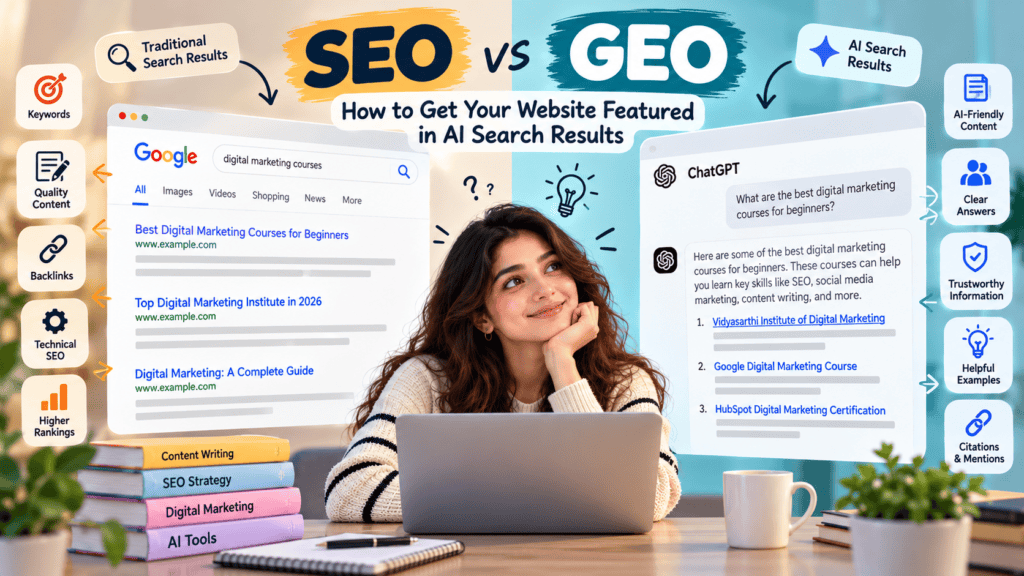
  • SEO vs GEO: How to Get Your Website Featured in AI Search Results

    SEO vs GEO: How to Get Your Website Featured in AI Search Results

    Picture of Anshu Tyagi

    Anshu Tyagi

    Hi, I’m Anshu, a digital marketing learner who loves exploring new ideas, learning new skills, and understanding the digital world. I enjoy turning what I learn into simple, meaningful content that helps others learn and grow.

    Table of Contents

    Introduction

    Have you ever searched for something on Google and noticed that you get an AI-generated answer even before clicking on any website? Or maybe you have asked ChatGPT a question and received a detailed answer with links to different websites.

    This is how search is changing!

    Earlier, people mostly depended on search engines like Google to find information. They typed a query, clicked on a few websites, and searched for the answers they needed. But now, AI tools are also helping people discover information in a completely different way.

    And this brings us to two important terms: SEO and GEO.

    You might already know about SEO, but have you heard about GEO? No worries if you haven’t! In this blog, we will understand the difference between SEO and GEO, why GEO is becoming important, and how you can optimize your website to improve its chances of appearing in AI-generated search results.

    Let’s understand everything step by step.

    What Is SEO?

    SEO stands for Search Engine Optimization.

    In simple words, SEO is the process of improving your website and its content so that search engines like Google can understand it better and show it to people searching for related information.

    For example, imagine you have a website where you publish blogs about digital marketing. If someone searches for “best digital marketing tips for beginners,” you want your blog to appear in the search results.

    To improve your chances of ranking, you can:

    • Use relevant keywords in your content.

    • Write helpful and informative blogs.

    • Add clear headings and subheadings.

    • Improve your website’s loading speed.

    • Make your website mobile-friendly.

    • Add internal links to related pages.

    • Earn relevant backlinks from trustworthy websites.

    All these activities can help search engines understand your content and make it easier for people to discover your website.

    The main goal of SEO is to improve your website’s visibility in traditional search results and attract relevant visitors.

    What Is GEO?

    GEO stands for Generative Engine Optimization.

    It refers to the process of creating and improving content so that AI-powered search experiences can understand it and potentially use it when generating answers.

    Let’s understand this with an example.

    Suppose someone asks an AI search tool, “Which digital marketing skills should a beginner learn?”

    The tool may generate an answer explaining important skills such as SEO, content writing, social media marketing, email marketing, and paid advertising. It may also provide links to websites that offer useful information.

    Now, imagine your website has a helpful, well-organized article explaining these skills. Your content could potentially be considered as a source for an AI-generated answer.

    That is where GEO comes in.

    GEO focuses on making your content clear, useful, trustworthy, and easy for AI systems to understand.

    However, remember one important thing: GEO does not guarantee that an AI tool will mention or recommend your website. The final result depends on how the particular search or AI system works.

    SEO vs GEO: What Is the Difference?

    SEO and GEO have a similar purpose: helping people discover useful content. However, they focus on different types of search experiences.

    SEOGEO
    SEO stands for Search Engine Optimization.GEO stands for Generative Engine Optimization.
    Focuses on improving visibility in traditional search results.Focuses on improving the chances of being included or cited in AI-generated answers.
    Helps search engines understand and rank web pages.Helps AI-powered search systems understand and potentially use your content.
    Uses relevant keywords, helpful content, technical optimization, and backlinks.Emphasizes clear answers, useful information, trustworthy sources, and well-structured content.
    May bring visitors through traditional search listings.May help users discover your website through AI-generated answers and citations.

    So, should you choose SEO or GEO?

    Honestly, you don’t need to choose just one.

    SEO and GEO can work together. A website with useful content, a good technical foundation, and clear information can build a stronger presence across different search experiences.


    Why Is GEO Becoming Important?

    People are changing the way they search for information. Instead of only typing short keywords into a search engine, they are also asking complete questions through AI-powered tools.

    For example, someone might search for “SEO tips” on Google. But when using an AI assistant, they might ask, “How can I improve the SEO of my small business website with a limited budget?”

    The second question is more conversational and specific.

    Here are a few reasons why GEO is getting attention.

    1. People Are Asking AI Tools More Questions

    AI-powered tools can help users understand topics, compare options, and find answers in a conversational way.

    This means businesses and content creators have another search experience to consider when planning their online visibility.

    2. AI Search Can Introduce Users to Websites

    Some AI search experiences include links and citations to sources used in their answers. When your website is included, users may have an opportunity to visit it and explore your content.

    This can create another discovery opportunity for your website, although being included is never guaranteed.

    3. Helpful Content Still Matters

    Think about it. If your content is confusing, outdated, or filled with unnecessary information, it becomes harder for readers to understand what you are trying to explain.

    On the other hand, when your content answers questions clearly and provides useful information, it becomes more valuable to readers.

    This is why creating genuinely helpful content should remain a priority, whether you are working on SEO or GEO.


    How to Optimize Your Website for AI Search Results

    Now that we understand SEO and GEO, let’s look at some practical ways to improve your content and website.

    1. Answer Your Audience’s Questions Clearly

    One of the simplest ways to improve your content is to understand what your audience actually wants to know.

    Before writing a blog, think about the questions your readers might have.

    For example, if you are writing about SEO, your audience might ask:

    • What is SEO?

    • How does SEO work?

    • Why is SEO important for a business?

    • How can beginners learn SEO?

    • What are the common SEO mistakes?

    Try to answer these questions directly instead of making readers go through several paragraphs before finding the main point.

    You can also add an FAQ section at the end of your blog to address related questions.

    The goal is simple: make your content genuinely useful for the person reading it.


    2. Use Clear Headings and Simple Language

    Imagine opening a blog and finding one huge block of text without any headings or breaks. Would you enjoy reading it?

    Probably not!

    Clear headings help readers understand what each section is about. They also help search systems interpret the structure of your content.

    Here are a few things you can do:

    • Use one clear H1 heading for your main blog title.

    • Use H2 headings for the main sections.

    • Use H3 headings for smaller topics within a section.

    • Keep paragraphs short and easy to read.

    • Use bullet points when listing information.

    • Explain difficult terms in simple language.

    For example, instead of using a vague heading like “Important Things,” write “5 SEO Tips for Beginners.”

    The second heading tells readers exactly what they can expect.


    3. Create Trustworthy and Accurate Content

    Would you trust a website that shares information without checking whether it is correct?

    Probably not. And your readers deserve better than that.

    When creating content, focus on accuracy, transparency, and usefulness. Google’s content guidance also emphasizes aspects of experience, expertise, authoritativeness, and trustworthiness, commonly known as E-E-A-T.

    You can build trust by:

    • Checking facts before publishing.

    • Using reliable sources for important claims.

    • Adding relevant examples from real experience when possible.

    • Mentioning the author of the content.

    • Updating information when it becomes outdated.

    • Being honest about what you know and what you don’t.

    You don’t need to pretend to be an expert in everything. Share what you understand, do your research, and explain the topic responsibly.

    Trust takes time to build, but it is an important part of creating a valuable website.


    4. Add Original Insights and Examples

    Let’s say ten different websites explain the same topic using almost identical information. Why would a reader choose one over another?

    This is where your unique perspective can make a difference.

    Instead of simply repeating information available everywhere, try to add something useful of your own.

    For example, if you are writing about content marketing, you could include:

    • An example of a content marketing campaign.

    • A personal learning experience.

    • A practical step-by-step explanation.

    • A comparison that makes a difficult concept easier to understand.

    • Lessons learned from testing a particular strategy.

    You don’t need to share a personal story in every blog. Even a clear, original example can help readers understand the topic better.

    Your goal should be to add value, not just add more words.


    5. Maintain a Technically Healthy Website

    Good content is important, but your website also needs a strong technical foundation.

    If search engines cannot access or index your pages, your content may struggle to appear in search results.

    Here are some basic things to check:

    • Make sure important pages are accessible to search engines.

    • Check for accidental noindex settings on pages you want indexed.

    • Maintain a clear website structure.

    • Use descriptive page titles and meta descriptions.

    • Make your website mobile-friendly.

    • Improve loading speed and page experience.

    • Fix broken internal links.

    • Use an XML sitemap where appropriate.

    These practices support your overall SEO efforts and can also help eligible pages be discovered in AI-powered search experiences.

    Remember that technical optimization does not guarantee rankings or AI citations, but it helps remove avoidable barriers to discovery.


    6. Use Structured Data Correctly

    Have you ever noticed that some search results display additional information, such as product details, ratings, or event information?

    Structured data can help search engines understand specific information on a web page.

    For example, if you publish a recipe, you may use suitable recipe structured data to describe details such as ingredients and cooking time.

    Similarly, different types of websites may use relevant structured data when it accurately describes their content.

    However, don’t add structured data just because you think it will automatically get your website featured in AI answers.

    Use it only when it is relevant, follow the applicable guidelines, and make sure it matches the visible content on your page.

    There is no special GEO schema that guarantees your content will appear in AI-generated answers.


    7. Make Sure AI Search Tools Can Discover Your Website

    This is an important point that website owners should not overlook.

    Some AI-powered search experiences rely on information retrieved from the web. If you want your content to be eligible for discovery through a particular service, check how that service accesses websites.

    For example, OpenAI uses a crawler called OAI-SearchBot for search-related purposes in ChatGPT.

    If you want your website to be eligible for inclusion in ChatGPT Search results, check your website’s robots.txt file and server settings to ensure that OAI-SearchBot is not unintentionally blocked.

    You can review OpenAI’s official guidance here:

    https://platform.openai.com/docs/bots

    Keep in mind that allowing a crawler to access your website does not guarantee that your pages will appear in ChatGPT Search answers.

    Different AI services may use different systems and have different crawling requirements, so check the official documentation for the platforms that matter to your business.


    8. Track Your Results and Keep Improving

    SEO and GEO are not activities you complete once and forget about.

    You need to observe how your content performs and make improvements whenever necessary.

    For traditional SEO, tools such as Google Search Console and Google Analytics can help you understand search visibility, clicks, website traffic, and user behavior.

    For AI search visibility, you can also look for relevant referral traffic, monitor mentions and citations where practical, and review whether your content is being discovered through the AI platforms important to your audience.

    Here are a few questions worth asking:

    • Are people finding my website through search engines?

    • Which pages are attracting visitors?

    • Are my articles answering the audience’s questions?

    • Is my information still accurate and up to date?

    • Are there new questions I should cover?

    • Can I make any section clearer or more useful?

    Use what you learn to improve your content over time.

    Don’t focus only on rankings or mentions. Also consider whether the right audience is finding your website and whether your content is actually helping them.


    Common GEO Mistakes You Should Avoid

    While working on GEO, it is easy to get distracted by new strategies and forget the basics.

    Here are some common mistakes to avoid.

    1. Ignoring SEO Completely

    GEO is not a reason to abandon SEO. Traditional SEO practices still matter for helping search engines discover, understand, and index your content.

    Build a solid SEO foundation while also thinking about AI-powered search experiences.

    2. Stuffing Keywords Everywhere

    Adding the same keyword repeatedly does not automatically make your content better.

    For example, if you are writing about digital marketing, you don’t need to include the phrase “best digital marketing course” in every paragraph.

    Use relevant terms naturally and focus on answering the reader’s question.

    3. Publishing AI-Generated Content Without Reviewing It

    AI tools can help you brainstorm ideas, organize information, and create drafts. However, they can also produce incorrect facts, outdated information, or generic explanations.

    Always review AI-generated content before publishing it. Check the facts, improve the examples, add your own perspective, and make sure the final article is genuinely useful.

    4. Writing Only for AI Tools

    It might be tempting to create content by thinking only about how an AI system will interpret it.

    But don’t forget the most important part: your readers.

    Write content that answers their questions, solves their problems, and helps them make informed decisions. Clear, reader-focused content is a better long-term foundation than trying to manipulate a search system.

    5. Believing Every GEO Trick You See Online

    As AI search continues to develop, you may come across claims that a particular formatting trick or special technique guarantees AI citations.

    Be careful with such promises.

    Search systems change, and no single tactic can guarantee that your website will be selected for an AI-generated answer.

    Focus on useful content, accessibility, accuracy, and a strong website experience instead of chasing every new trend.


    SEO and GEO: What Should You Focus on First?

    If you are a beginner, you might be wondering where to start.

    My suggestion is to build your SEO foundation first and then apply GEO-friendly content practices alongside it.

    Start with these steps:

    1. Understand your audience: Find out what your potential readers are searching for.

    2. Research relevant keywords and questions: Identify topics that match their needs.

    3. Create helpful content: Write clear, original, and accurate articles.

    4. Improve your website: Check its structure, accessibility, mobile experience, and loading speed.

    5. Organize your content: Use meaningful headings, short paragraphs, and relevant internal links.

    6. Build credibility: Check your facts, cite reliable sources, and share genuine experience where appropriate.

    7. Review performance: Use available analytics and search tools to understand what is working.

    Once these basics are in place, you can explore how your content performs across AI-powered search experiences and make improvements based on what you learn.

    You don’t have to do everything at once. Start small, stay consistent, and keep improving.


    Conclusion

    The way people search for information is changing. Traditional search engines remain important, while AI-powered tools are creating new ways for users to discover content.

    SEO helps improve your website’s visibility in traditional search results, while GEO focuses on improving the chances of your content being included or cited in AI-generated answers.

    But here’s the thing: SEO and GEO are not enemies, and you don’t need to choose between them.

    You can work on both by creating helpful content, answering questions clearly, maintaining a technically healthy website, sharing accurate information, and building trust with your audience.

    There is no guaranteed formula for getting featured in AI search results. However, focusing on your readers and making your content easy to discover and understand is a sensible place to start.

    So, if you are a blogger, business owner, content writer, or digital marketing beginner, now is a good time to understand these changes and start applying what you learn.

    Keep learning, keep experimenting, and remember that useful content always has a purpose beyond simply ranking on a search engine.


    Want to Learn More About Digital Marketing?

    If you are interested in learning SEO, content marketing, and other important digital marketing skills, exploring a structured learning path can be a helpful next step.

    You can visit Vidyasarthi Institute of Digital Marketing to explore its digital marketing learning opportunities and take the next step in your learning journey.

    Start with the basics, practise what you learn, and keep building your skills one step at a time!

    FAQs

    1. Is GEO important for beginners in digital marketing?

    Yes! Understanding GEO can help beginners prepare for the changing search landscape. Start by learning SEO fundamentals, creating helpful content, answering users’ questions clearly, and understanding how AI-powered search tools work. You don’t need to master everything at once; consistent learning and practice will help you improve over time.

    No, GEO does not replace SEO. Traditional SEO practices remain important for helping search engines discover and understand your website. Combining a strong SEO foundation with clear, trustworthy, and useful content can help you prepare for both traditional and AI-powered search experiences.

    No, there is no guaranteed method to get your website featured in AI-generated answers. The results depend on the AI platform, the user’s query, and other factors. Your best approach is to create valuable content, maintain your website properly, and keep improving your overall search visibility.

    You can improve your chances by creating helpful and accurate content, answering users’ questions clearly, using proper headings, maintaining a technically healthy website, and adding original insights. You should also make sure relevant pages can be discovered by the search systems you want to reach.

  • 15 Best AI Tools for Digital Marketing in 2026: A Beginner’s Guide

    15 Best AI Tools for Digital Marketing in 2026: A Beginner’s Guide

    Picture of Anshu Tyagi

    Anshu Tyagi

    Hi, I’m Anshu, a digital marketing learner who loves exploring new ideas, learning new skills, and understanding the digital world. I enjoy turning what I learn into simple, meaningful content that helps others learn and grow.

    Table of Contents

    Introduction

    Have you ever wondered how digital marketers create blogs, design attractive social media posts, research keywords, and manage marketing campaigns all at the same time? It may look like a lot of work, right?

    Well, this is where Artificial Intelligence (AI) comes into the picture.

    Today, AI is changing the way we work in digital marketing. Tasks that once took hours can now be completed much faster with the help of AI tools. From generating content ideas to analysing website traffic, these tools are helping marketers work smarter and save time.

    But here is something important to understand. You don’t need to learn every AI tool available in the market to become a good digital marketer. You just need to understand which tools can help you with your work and how to use them effectively.

    So, if you are a beginner who wants to explore AI in digital marketing, this blog is for you.

    Let’s discover the 15 best AI tools for digital marketing in 2026, what they do, and how you can start using them.

    What Are AI Tools in Digital Marketing?

    In simple words, AI tools are software applications that use artificial intelligence to help us perform different tasks more efficiently.

    In digital marketing, these tools can help with content creation, SEO, social media management, graphic design, email marketing, advertising, and data analysis.

    For example, imagine you want to write a blog about SEO but don’t know where to start. An AI writing tool can help you brainstorm ideas, prepare an outline, and organise your content.

    Similarly, if you want to create an Instagram post, an AI design tool can help you develop a creative design without starting everything from scratch.

    The main purpose of these tools is to make marketing tasks easier and help marketers focus more on planning, creativity, and strategy.

    15 Best AI Tools for Digital Marketing in 2026

    1. ChatGPT – Best for Content Creation

    If you are learning digital marketing, ChatGPT is one of the tools worth exploring first.

    It can help you generate blog ideas, write content drafts, prepare social media captions, create email drafts, and brainstorm marketing strategies.

    For example, if you want to write a blog about digital marketing trends, you can ask ChatGPT to suggest topics and create a blog outline.

    You can also ask it to explain difficult marketing concepts in simple English.

    Best for: Content writing, brainstorming, research assistance, and marketing ideas.

    2. Google Gemini – Best for Research and Brainstorming

    Google Gemini is another AI tool that can help digital marketers with research, writing, and idea generation.

    Suppose you are planning a social media campaign for a clothing brand. You can use Gemini to brainstorm campaign ideas, suggest content themes, and organise your marketing plan.

    It can also help you summarise information and explore different approaches to a topic.

    However, always verify important facts before using them in your content.

    Best for: Research assistance, brainstorming, summarising, and content planning.

    3. Claude – Best for Working With Long Content

    Sometimes, writing a detailed blog or reviewing a long document can feel overwhelming.

    Claude can help you work with longer pieces of text, organise information, improve drafts, and develop structured content.

    For example, if you have prepared a rough blog draft, you can ask Claude to improve its flow while keeping the language simple and conversational.

    This can be useful when you want your content to sound natural rather than overly formal.

    Best for: Long-form writing, editing, summarising, and content organisation.

    4. Canva – Best for Graphic Design

    We all know that attractive visuals can make social media content more interesting.

    But what if you are not a professional graphic designer?

    Canva makes it easier to create social media posts, presentations, posters, and other marketing creatives. Its AI-powered features can also assist with design and content creation, depending on your plan. 

    For example, if you want to create an Instagram carousel about SEO tips, you can choose a template, add your content, and customise the design according to your brand.

    You don’t have to be an expert to get started.

    Best for: Social media posts, presentations, marketing graphics, and visual content.

    5. Adobe Firefly – Best for AI-Generated Visuals

    Have you ever had a creative idea but struggled to find the right image for it?

    Adobe Firefly can help you explore visual ideas and generate or edit images using AI features.

    For example, if you are creating a campaign for a travel company, you can use text prompts to develop visual concepts that match the campaign theme.

    These visuals can help you explore different creative directions before finalising your design.

    Always review the output and check the usage terms for your intended purpose.

    Best for: Generating visual concepts, editing images, and creating marketing creatives.

    6. Grammarly – Best for Improving Writing

    If you are a content writer, you already know how important grammar and clarity are.

    Sometimes, we know exactly what we want to say, but we struggle to express it correctly.

    Grammarly can help identify grammar mistakes, improve sentence clarity, and make your writing easier to understand. Its AI features can also assist with rewriting and drafting.

    For example, if you write a social media caption, Grammarly can help you make it clearer and more polished.

    It is particularly useful for beginners who want to improve their professional communication.

    Best for: Grammar checking, sentence improvement, and writing clarity.

    7. Jasper – Best for Marketing Content

    Jasper is an AI platform designed to support marketing content creation.

    It can help marketing teams develop content for different purposes while maintaining a consistent brand voice.

    For example, imagine a company needs product descriptions, advertising copy, email campaigns, and social media captions for the same product.

    Jasper can help create drafts for these different formats.

    Remember, you should still review the content to make sure it matches your audience, brand, and marketing goals.

    Best for: Marketing copy, brand-focused content, and campaign messaging.

    8. Copy.ai – Best for Marketing Copy and Workflows

    Copy.ai can help businesses generate marketing copy and organise certain repetitive content-related workflows.

    For example, if you are promoting a new online course, you may need an advertisement headline, a landing-page description, and an email introducing the course.

    An AI writing tool can help you develop the first drafts of these materials.

    You can then edit them according to your campaign objectives.

    Best for: Marketing copy, sales messaging, and content workflows.

    9. Semrush – Best for SEO Research

    Let’s talk about SEO.

    If you want your website to appear in search results, you need to understand what your audience is searching for and how your website can answer those questions.

    Semrush provides SEO and digital marketing tools that can help with keyword research, competitor analysis, website audits, and content planning.

    For example, if you are writing a blog about digital marketing courses, you can research related keywords and explore what topics competitors are covering.

    This can help you plan content based on search demand rather than guessing what people might want to read.

    Best for: Keyword research, competitor analysis, and SEO planning.

    10. Surfer SEO – Best for Content Optimisation

    Writing a good blog is important, but organising it around the topic and search intent also matters.

    Surfer SEO helps content creators analyse search results and optimise their content using relevant SEO recommendations.

    For example, if you have written a blog about email marketing, the tool can help you review its structure and identify opportunities to improve its coverage of the topic.

    However, don’t add keywords everywhere just because a tool suggests them. Your content should still sound natural and provide genuine value to readers.

    Best for: SEO content optimisation and improving blog structure.

    11. Ahrefs – Best for Keyword and Competitor Research

    Ahrefs is another useful platform for people who want to learn SEO.

    It offers tools for keyword research, backlink analysis, competitor research, and website performance analysis.

    Suppose your website is not getting much organic traffic. You can use SEO research tools to explore keyword opportunities and understand which pages or topics competitors are targeting.

    This information can help you make better decisions about your content strategy.

    Best for: Keyword research, backlink analysis, and competitor research.

    12. HubSpot Breeze – Best for Marketing Automation

    Imagine managing leads, sending emails, creating content, and tracking customer interactions across different platforms.

    It can become difficult to manage everything manually.

    HubSpot’s Breeze AI features support marketing, sales, and customer-service workflows. Depending on the product and plan, these features can help with content creation, information retrieval, and automation. 

    For example, a business can use its marketing platform to organise customer information and support communication with potential customers.

    Beginners can explore how AI fits into a larger marketing process rather than treating each task separately.

    Best for: Marketing workflows, CRM support, and customer engagement.

    13. Mailchimp – Best for Email Marketing

    Email marketing is still a useful way for businesses to communicate with their audience.

    But writing emails, organising subscribers, and creating campaigns regularly can take time.

    Mailchimp provides email marketing tools, including AI-assisted features for certain content and campaign tasks.

    For example, if a business wants to announce a new product, it can use AI assistance to brainstorm subject lines and prepare an email draft.

    The marketer can then personalise the message and make sure it suits the audience.

    Best for: Email campaigns, audience communication, and campaign management.

    14. Google Ads AI Features – Best for Advertising Campaigns

    If you want to learn paid advertising, Google Ads is an important platform to understand.

    Its AI-powered features can support campaign creation, bidding, targeting, and optimisation, depending on the campaign type and available features.

    For example, an online store can use automated bidding strategies to help optimise its advertising towards a chosen goal.

    But AI cannot decide your entire marketing strategy for you. You still need to understand your target audience, budget, campaign objectives, and conversion tracking.

    Best for: Paid search, campaign optimisation, and advertising performance.

    15. Google Analytics 4 – Best for Understanding Marketing Results

    Now, imagine you have published a blog, created social media posts, and launched an advertising campaign.

    How will you know whether your efforts are working?

    This is where Google Analytics 4 (GA4) becomes useful.

    GA4 helps you understand how people discover and interact with your website or app. Its machine-learning capabilities can also provide insights from collected data to support marketing decisions. 

    For example, you can explore which channels bring visitors to your website and whether users complete important actions, such as submitting a form or making a purchase.

    This helps you understand the difference between simply getting traffic and achieving meaningful business results.

    Best for: Website analytics, user behaviour, and conversion measurement.

    Which AI Tools Should Beginners Learn First?

    Now, after looking at 15 tools, you might be wondering, “Do I need to learn all of them?”

    Honestly, no.

    Learning every tool at once can make things confusing, especially when you are just starting.

    Instead, choose tools according to the type of work you want to learn.

    Here is a simple starting point:

    • For content writing: Start with ChatGPT and Grammarly.

    • For graphic design: Explore Canva.

    • For SEO: Learn Semrush or Ahrefs.

    • For content optimisation: Explore Surfer SEO.

    • For email marketing: Start with Mailchimp.

    • For paid advertising: Learn Google Ads.

    • For analytics: Start with Google Analytics 4.

    You can explore other tools as you become more comfortable with the basics.

    The goal is not to collect AI tools. It is to understand how to use them to solve marketing problems.

    How to Use AI Tools Effectively in Digital Marketing

    Learning the names of different tools is only the first step. The real learning begins when you start using them.

    Here are a few practical tips for beginners.

    1. Understand Digital Marketing Basics First

    Before using AI for SEO, learn how keywords, search intent, and website optimisation work.

    Before using AI for advertising, understand your audience, budget, and campaign objectives.

    When your basics are clear, you can use AI more effectively.

    2. Give Clear Instructions

    The quality of an AI response often depends on the instructions you provide.

    Instead of asking, “Write an Instagram post,” try giving more details.

    For example:

    “Create an Instagram caption for a digital marketing institute targeting college students. Use simple English, explain one benefit of learning digital marketing, and end with a clear call to action.”

    This gives the tool a better understanding of what you need.

    3. Always Review AI-Generated Content

    AI can make mistakes, provide outdated information, or generate content that sounds too generic.

    So, check facts, edit the language, and add your own ideas before publishing anything.

    Remember, your audience deserves useful and trustworthy content.

    4. Practise With Real Projects

    Choose a small project and apply what you learn.

    For example, you can create a content calendar for a local business, prepare a blog outline, design an Instagram post, or analyse a website’s traffic.

    This will help you understand how different tools work together in a real marketing situation.

    5. Measure Your Results

    Don’t judge your work only by how quickly you complete it.

    Check whether your content attracts the right audience, whether your campaigns generate leads, and whether your website visitors take meaningful actions.

    AI is a tool to support your work. Your strategy and results are what really matter.

    Conclusion

    AI tools are making digital marketing more accessible by helping marketers create content, design visuals, research keywords, manage campaigns, and analyse results.

    From ChatGPT and Canva to Semrush and Google Analytics 4, every tool serves a different purpose.

    But you don’t need to become an expert in all 15 tools overnight.

    Start with a few tools that match your interests, practise regularly, and gradually explore more advanced features.

    And remember, AI is not a replacement for learning digital marketing. It is a way to improve how you apply your knowledge.

    The more you understand marketing, the better you can use AI to support your work.

    Ready to Start Your Digital Marketing Journey?

    If you are a beginner who wants to learn digital marketing but doesn’t know where to start, don’t worry. You can begin by understanding the basics and building your skills step by step.

    At Vidyasarthi Institute of Digital Marketing, you can explore learning opportunities that can help you move forward in your digital marketing journey.

    Learn about digital marketing, understand how different strategies work, and explore how modern tools can support your skills.

    Visit Vidyasarthi Institute of Digital Marketing to explore your learning options and take the next step towards your digital marketing goals.

    Don’t just learn about the tools. Learn how to use them with purpose, creativity, and confidence!

    FAQs

    1. Are AI tools free to use for digital marketing?

    Many AI tools offer free plans or limited free features, while some advanced features require a paid subscription. For beginners, free versions are often enough to explore different tools and practise basic digital marketing tasks.

    Yes, you can learn digital marketing without AI tools. However, understanding how to use AI can help you save time, generate ideas, and improve your workflow. The most important thing is to learn digital marketing fundamentals and then use AI to support your skills.

    AI can automate repetitive tasks, but digital marketing also requires creativity, communication, strategic thinking, and an understanding of customer behaviour. Learning to use AI effectively can help digital marketers work more efficiently and adapt to changes in the industry.

    Beginners can start with ChatGPT for content writing, Canva for graphic design, Semrush for SEO research, Grammarly for improving writing, and Google Analytics 4 for tracking website performance. Start with a few tools and learn how to use them through practice.

  • How AI is transforming digital marketing in 2026 : Trends , tools and strategies for beginners

    How AI Is Transforming Digital Marketing in 2026: Trends, Tools, and Strategies for Beginners

    Picture of Anshu Tyagi

    Anshu Tyagi

    Hi, I’m Anshu, a digital marketing learner who loves exploring new ideas, learning new skills, and understanding the digital world. I enjoy turning what I learn into simple, meaningful content that helps others learn and grow.

    Table of Contents

    Introduction

    Have you ever wondered how brands create so much content, run multiple ad campaigns, and connect with thousands of customers at the same time? Well, one of the biggest reasons behind this is Artificial Intelligence (AI).

    Today, AI is changing the way businesses work, and digital marketing is no exception. From writing blog posts and creating social media content to understanding customer behaviour and running advertisements, AI is making many marketing tasks faster and easier.

    Think about it. Earlier, a digital marketer had to spend hours researching keywords, analysing competitors, creating content, and checking campaign performance. But now, AI tools can help with many of these tasks in much less time.

    So, does this mean AI will replace digital marketers? Not exactly. AI can help us work smarter, but creativity, human understanding, and strategic thinking are still important.

    If you are a beginner who wants to enter the digital marketing field, understanding AI can give you a useful advantage.

    Let’s explore how AI is transforming digital marketing in 2026, the latest trends, useful tools, and strategies you can start learning today.

    What Is AI in Digital Marketing?

    In simple words, AI in digital marketing means using artificial intelligence to understand customers, create content, analyse data, automate tasks, and improve marketing campaigns.

    For example, imagine you run an online clothing store. You want to know which products your customers like, what kind of content attracts them, and which advertisements bring more sales.

    AI tools can help you analyse this information and identify useful patterns.

    Similarly, AI can help you generate social media captions, suggest blog topics, create email drafts, and understand campaign performance.

    The main purpose is simple: to save time, make better decisions, and create more effective marketing strategies.

    How AI Is Transforming Digital Marketing in 2026

    1. AI Is Making Content Creation Easier

    Content is an important part of digital marketing. Whether we talk about blogs, Instagram posts, videos, or emails, businesses need content to communicate with their audience.

    But creating fresh content regularly can be challenging.

    This is where AI comes in.

    Tools like ChatGPT and Google Gemini can help marketers brainstorm ideas, prepare blog outlines, write first drafts, and create social media captions.

    For example, if you run a digital marketing institute, you can use AI to brainstorm topics like “5 Digital Marketing Skills Every Beginner Should Learn.”

    You can then use those ideas to create a blog, an Instagram carousel, or a short video.

    However, there is one thing to remember. AI-generated content should not be published blindly. You need to check the facts, add your own ideas, and make sure the content sounds natural.

    AI can help you create content faster, but your own thinking is what makes it meaningful.

    2. AI Is Changing SEO and Online Search

    SEO, or Search Engine Optimization, is the process of improving a website so that search engines can understand its content and help users discover it.

    Earlier, many marketers focused mainly on keywords and website rankings. These are still important, but search behaviour is also changing.

    People are increasingly using conversational searches and AI-powered search experiences to find information.

    For example, instead of searching “best digital marketing course,” someone might ask, “Which digital marketing course is suitable for a beginner who wants to build a career?”

    This means marketers need to create helpful, clear, and trustworthy content that answers real questions.

    AI tools can help you discover topic ideas, organise keywords, identify content gaps, and understand search intent.

    But remember, simply adding keywords or generating hundreds of AI-written articles will not guarantee higher rankings.

    Your content should genuinely help readers.

    3. AI Is Making Advertising Smarter

    Have you ever noticed advertisements for products related to something you recently searched for? Digital advertising uses different signals and technologies to help businesses reach relevant audiences.

    AI is making this process more advanced.

    Advertising platforms such as Google Ads use AI-powered features to help with bidding, campaign optimisation, and creative variations.

    For example, an online store selling shoes can use AI-powered advertising features to improve how its campaigns reach potential customers.

    AI can also help marketers test different headlines, understand campaign results, and identify opportunities for improvement.

    Google’s 2026 marketing announcements also highlight AI-powered advertising experiences designed to connect customers with relevant products and information.

    The important thing for beginners is to understand that running advertisements is not just about spending money. You also need to understand your audience, set clear goals, track conversions, and measure results.

    4. Personalisation Is Becoming More Important

    Let’s say you receive an email that recommends products you are actually interested in. You are more likely to pay attention to it than an email promoting random products.

    This is the idea behind personalisation.

    AI can help businesses analyse customer preferences and organise audiences into different groups. Marketers can then create more relevant emails, recommendations, and marketing messages.

    For example, a fitness brand might send workout tips to beginners and advanced training content to experienced fitness enthusiasts.

    The goal is to make communication more relevant to each audience.

    However, personalisation should always respect customer privacy. Businesses need to handle customer information responsibly and follow applicable data protection rules.

    5. AI Is Helping Businesses Automate Repetitive Tasks

    Digital marketing involves many small tasks that take time.

    Replying to common questions, preparing reports, organising leads, drafting emails, and scheduling content can sometimes become overwhelming.

    AI and automation tools can help reduce this workload.

    For example, a business can use a chatbot to answer common questions about its products or services. More advanced AI assistants can also help organise information and support certain customer-service tasks.

    This allows marketers to spend more time on planning, creativity, and understanding customer needs.

    But automation does not mean removing humans from every interaction. Complicated questions and sensitive situations may still require a real person.

    Best AI Tools for Digital Marketing Beginners

    If you are new to digital marketing, you don’t need to learn every AI tool available in the market. Start with a few tools and understand how they fit into your work.

    Here are some useful options:

    • ChatGPT: Useful for brainstorming, blog outlines, content drafts, and marketing ideas.

    • Google Gemini: Can help with research, writing, summarising information, and analysing content.

    • Canva: Useful for designing social media posts, presentations, and marketing creatives, with AI features available in supported plans.

    • Grammarly: Helps improve grammar, clarity, and the readability of your writing.

    • Google Analytics 4: Helps you understand website traffic, user behaviour, and conversions. Its reporting and insights can support data-driven marketing decisions.

    Each tool has a different purpose, and features may vary depending on the plan.

    My suggestion? Start with one content tool and one design tool. Practise using them for actual marketing tasks before moving to more advanced tools.

    How Beginners Can Use AI in Digital Marketing

    Now that we understand the trends and tools, let’s talk about how you can start using AI in your learning journey.

    Step 1: Learn the Basics of Digital Marketing

    Before depending on AI, understand the basics of SEO, content marketing, social media marketing, email marketing, and paid advertising.

    Otherwise, you may generate content or campaign ideas without knowing whether they are actually useful.

    Step 2: Practise Writing Better Prompts

    AI tools respond to the instructions you give them.

    For example, instead of writing, “Write a blog about SEO,” try:

    “Write a beginner-friendly blog explaining SEO in simple English. Include examples, clear headings, and practical tips.”

    The second prompt gives the tool more direction.

    You can improve your results by mentioning your target audience, tone, purpose, and expected format.

    Step 3: Combine AI With Your Own Creativity

    Don’t use the first answer AI gives you.

    Read it, question it, check the facts, and add your own examples or observations.

    For example, if AI suggests ten Instagram content ideas, choose the ones that actually match your audience and brand.

    Your judgement is what helps turn a general idea into a useful marketing strategy.

    Step 4: Measure Your Results

    Digital marketing is not just about creating content. It is also about understanding what works.

    If you publish a blog, check its traffic and search performance. If you run an advertisement, monitor conversions and cost per result. If you post a reel, look beyond views and consider engagement and relevant actions.

    Use these insights to improve your next campaign.

    The best way to learn AI in digital marketing is to experiment, analyse, and keep improving.

    Conclusion

    AI is transforming digital marketing in 2026 by making content creation easier, improving advertising, supporting personalisation, and helping businesses understand their customers.

    But AI is not a magic solution that guarantees success. You still need to understand your audience, create useful content, develop marketing strategies, and measure your results.

    If you are a beginner, don’t feel pressured to learn every tool at once. Start with the basics, explore a few AI tools, and practise using them in real marketing tasks.

    Remember, the goal is not just to learn how to use AI. It is to understand how to use AI to become a better digital marketer.

    Ready to Start Your Digital Marketing Journey?

    If you are interested in digital marketing but don’t know where to begin, this is a great time to start learning.

    At Vidyasarthi Institute of Digital Marketing, you can explore your learning options and take the next step towards building your digital marketing skills.

    Learn about the field, understand how digital marketing strategies work, and start developing the knowledge you need to grow in this industry.

    Visit Vidyasarthi Institute of Digital Marketing today and explore the learning opportunities available to you.

    Don’t just watch the digital world change around you. Start learning the skills that can help you become a part of it!

    1. Which AI tools should beginners learn for digital marketing?

    Beginners can start with ChatGPT for content creation, Google Gemini for research and brainstorming, Canva for designing social media posts, Grammarly for improving writing, and Google Analytics 4 for understanding website performance. Start with a few tools and practise using them for real marketing tasks.

    AI can automate many repetitive marketing tasks, but it cannot replace the importance of human creativity, emotional understanding, and strategic thinking in every situation. Digital marketers who learn to use AI effectively can improve their productivity and make better decisions. The key is to combine AI tools with digital marketing knowledge and human skills.

  • Hello world!

    Welcome to WordPress. This is your first post. Edit or delete it, then start writing!